
Circuit Breaker Replacement
CIRCUIT BREAKER REPLACEMENT IN Phoenix, AZ
A circuit breaker lasts about 30 to 40 years, and heat shortens that, which matters where NEC ampacity tables assume an 86°F ambient that a garage panel passes every June. MaxCharged provides circuit breaker replacement in Phoenix, AZ: faulty breakers swapped for listed matches, EV charger breakers sized for continuous load, GFCI and AFCI breakers, tandem breakers where the panel allows, torque and load testing, and obsolete panel assessment. Licensed and insured, with 10 years of EV charger work behind us.
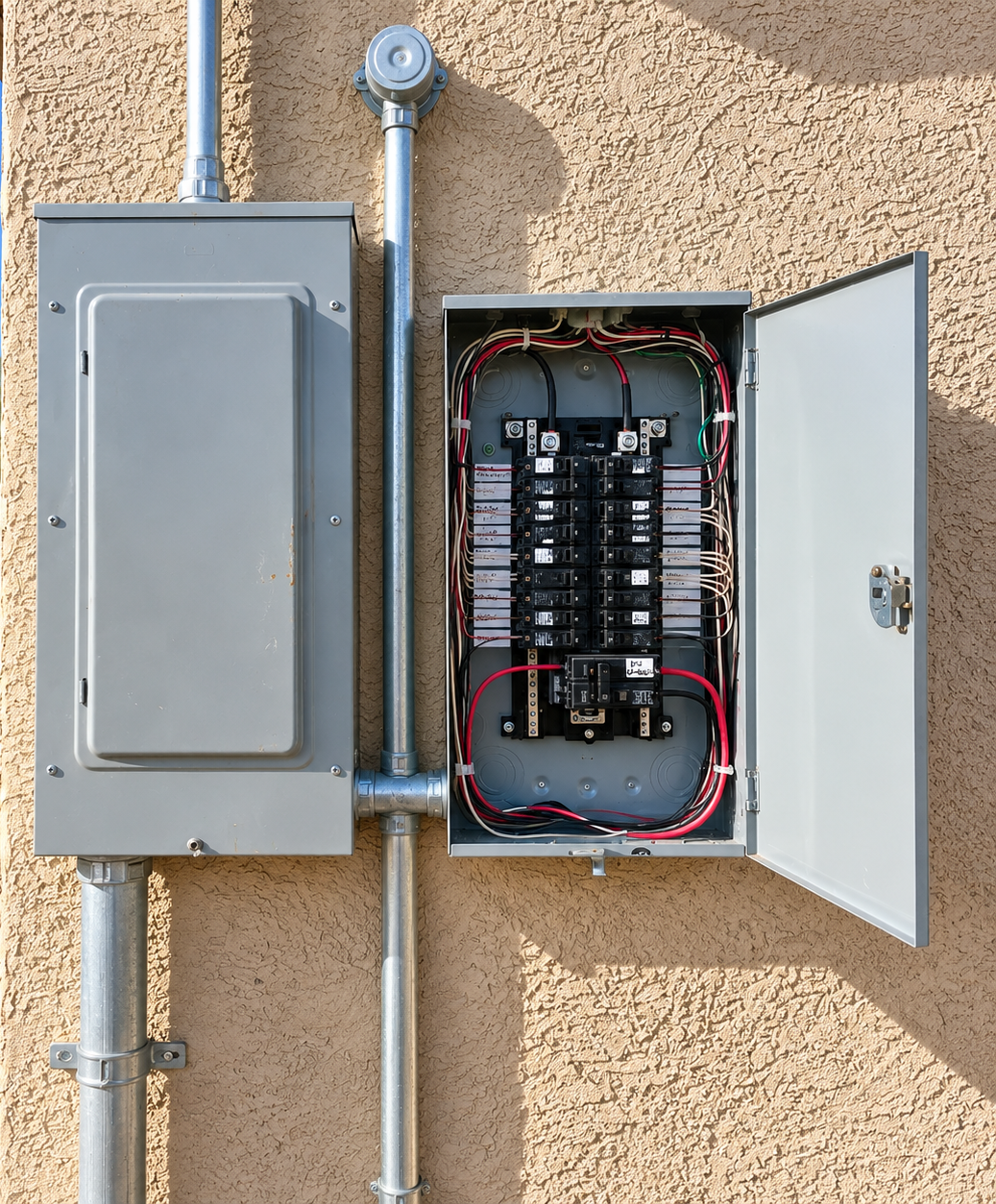
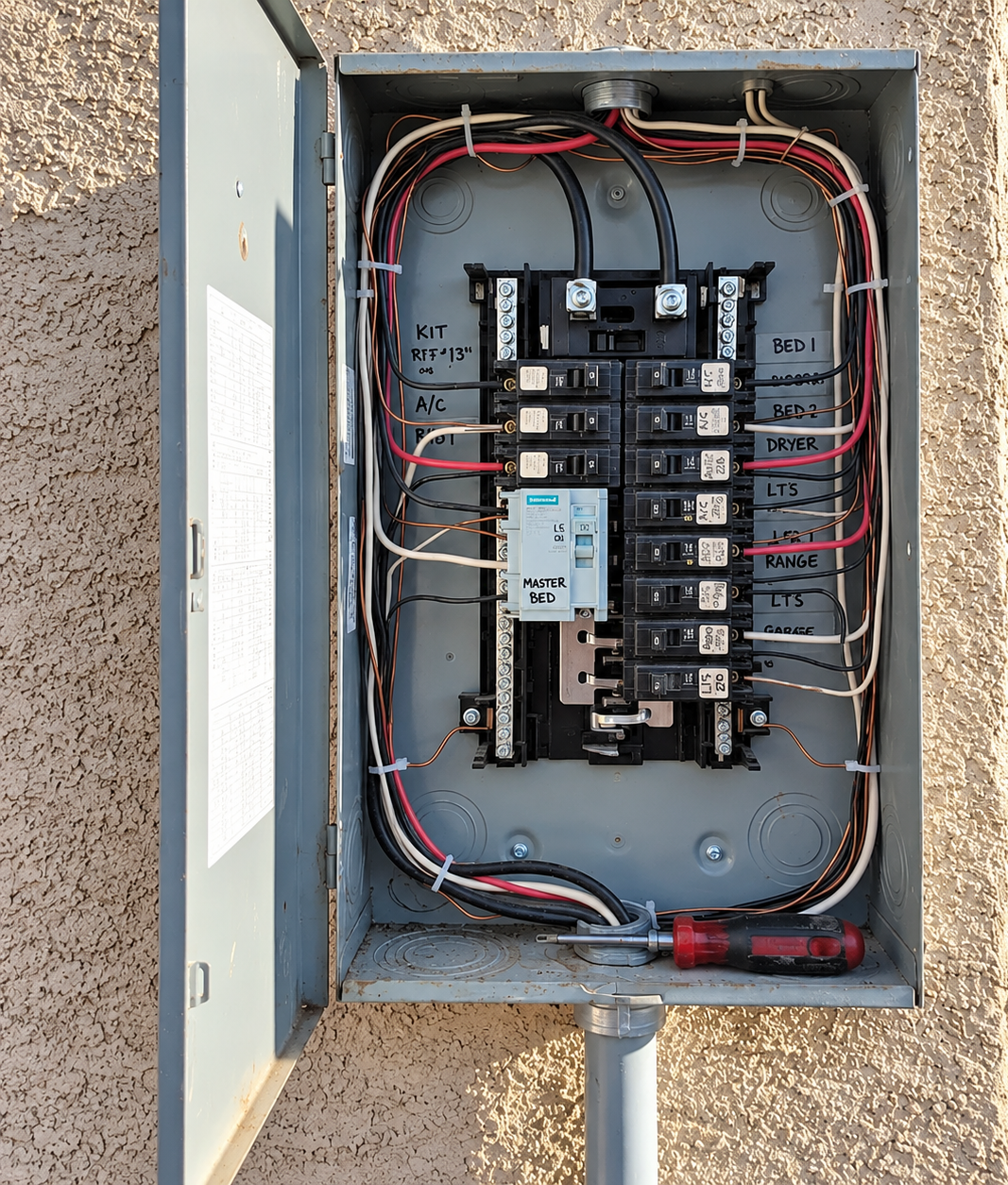
ONE BREAKER, DONE RIGHT, IS OFTEN THE WHOLE FIX.
Not every tripping breaker means a panel problem. A breaker that has cycled thousands of times in a 120°F garage gets weak and trips below its rating, or refuses to reset. Swapping it for a listed replacement, torqued to the manufacturer's setting, restores the circuit. We check wiring and load first so the new breaker is not covering for a deeper fault.
You get a diagnosis, a breaker that matches the panel, and a test under the actual load the circuit carries. If the panel itself is obsolete, we tell you before ordering parts.
✓ Matched to your panel brand
✓ Torqued to manufacturer specification
✓ Tested under real load
✓ EV charger breakers sized right
CIRCUIT BREAKER REPLACEMENT
GARAGE HEAT WEARS OUT BREAKERS EARLY.
A breaker trips on heat, by design. Its thermal element is calibrated for a room that is not 125°F, so a Phoenix, AZ garage panel runs closer to its trip point, and the extra cycling ages the mechanism. Add a continuous load like a charger running 6 hours a night and the weak ones start tripping at 2 a.m. We replace the tired breaker and check whether the conductor was sized for the heat.
AT 114°F, THE WIRE IS RATED FOR LESS THAN IT SAYS.
NEC conductor ampacity tables assume an 86°F ambient. Between 114 and 122°F, the range a Maricopa County garage panel reaches in summer, a 90°C conductor is derated to 82% of its table value and a 75°C conductor to 75%. A breaker that looks correctly sized on paper may be protecting a wire that can carry less than the label says, and we answer that before any replacement goes in.
A BREAKER THAT KEEPS TRIPPING IS TELLING YOU SOMETHING.
Over 10 years of wiring chargers we have learned to listen before we replace. Four faults produce the same 2 a.m. trip: a loose termination, a conductor too small for the heat, a breaker worn by continuous load, or GFCI protection doubled up between breaker and charger. Only one is cured by a new breaker. We find which one you have and leave the rest alone. What has your panel been trying to tell you?
WHY CHOOSE US FOR CIRCUIT BREAKER REPLACEMENT.
The Cause Found First
New breakers on a circuit with a loose connection trip again next week. We check the terminations, the wire gauge, and the connected load before parts come out of the truck, so the replacement solves the problem instead of hiding it.
Listed For Your Exact Panel
Every breaker has to be listed for the specific panel brand and model it goes into, and a look-alike that fits the bus is not the same thing. We verify the panel label and install only what the manufacturer approves for it.
Never A Bigger Breaker
Upsizing a breaker to stop trips removes the protection the wire depends on. If the circuit needs more capacity, the fix is a larger conductor or a dedicated circuit, and you get that recommendation instead of a shortcut that could start a fire.
Torque Verified, Not Guessed
Loose terminals are the leading source of heat in a panel. Every replacement breaker is torqued to the manufacturer's setting with a calibrated driver and marked, so the connection stays tight through the thermal cycling a garage panel sees every summer.
Protection The Room Requires
When a bathroom, garage, kitchen, or bedroom circuit gets a new breaker, it gets the GFCI or AFCI protection the current code assigns to that room. A replacement is the moment to bring the circuit up to date without opening any walls.
Plain Talk On Obsolete Panels
Some panels have no safe replacement breakers, and some brands should not be serviced at all. We identify those on the first visit and lay out the panel options, rather than installing a questionable part in a panel that should be retired.
WHAT WE REPLACE
OUR CIRCUIT BREAKER REPLACEMENT WORK
Breaker work is quick when the panel cooperates and impossible when it does not. These 6 services cover the calls we get, from a single failed breaker to the assessment that tells you the panel itself is the problem.

WORN OUT
Faulty Breaker Replacement
Trips below rating, refuses to reset, feels hot, or shows scorching at the terminal: the breaker is done. It comes out, the conductor end is inspected and trimmed back to clean copper if needed, and a listed replacement goes in and gets torqued.

EV SIZED
EV Charger Breaker Sizing
Charging is a continuous load, so the breaker carries a margin above the charger's draw: a 50-amp breaker for a 40-amp charger, 60 amps for a 48-amp Wall Connector. We confirm the conductor supports that rating in garage heat and remove doubled-up GFCI.
PROTECTED
GFCI and AFCI Breaker Installation
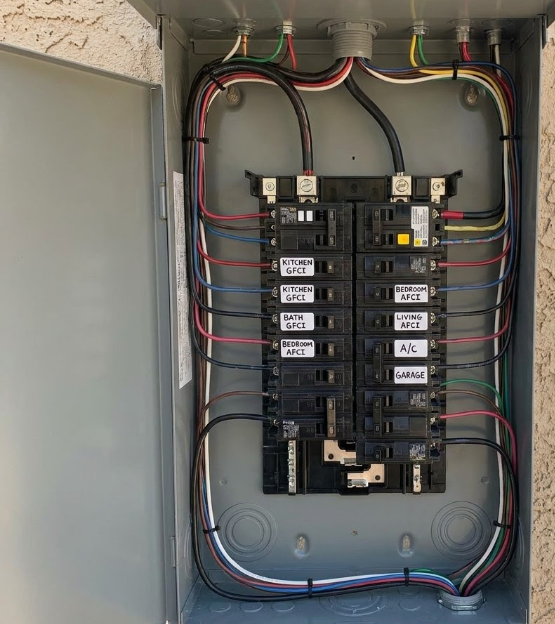
Ground-fault breakers protect people in wet areas by detecting current leaking to ground; arc-fault breakers protect the house by detecting arcing in bedroom and living-area wiring. Either can replace a standard breaker at the panel, bringing an older circuit up to current rules.

SPACE SAVER
Tandem Breaker Installation
Two circuits in one breaker position, where the panel is listed for it. Tandems free space for a new circuit without a subpanel, but only in the slots the manufacturer allows, and only when the load calculation shows the bus can carry it.

TORQUED
Torque and Load Testing
Every terminal in the panel gets checked against the manufacturer's torque value, and the circuit is run at its working load while we watch breaker temperature and voltage drop. A connection that passes both is a connection that will not overheat next July.

OBSOLETE
Obsolete Panel Assessment
Federal Pacific, Zinsco, and other panels with no listed replacement breakers get a clear verdict rather than an improvised part. You learn what the panel is, why compatible breakers cannot be sourced reliably, and what the replacement path looks like from here.
THE WORD ON OUR WORK
WHAT OUR CLIENTS SAY.
Breaker calls are the ones people mention months later, because the tripping stopped and stayed stopped. Reviewers tend to note that the visit ended with an explanation of what had failed and why, not just a new part in the panel. See what Valley homeowners wrote about the experience.
Common questions
FREQUENTLY ASKED QUESTIONS.
Most breaker questions start with a trip that will not stop. Below: how to tell a bad breaker from a bad circuit, what replacements must match, and when the panel is the real issue.
How can I tell if a circuit breaker is bad?
A bad breaker trips often at loads it used to carry, will not stay reset, feels hot to the touch, shows scorch marks or discoloration, or gives off a burning smell. Any of those signs calls for a look inside the panel.
Why does my breaker trip with nothing plugged in?
A trip on an empty circuit points to a short or ground fault in the wiring or a wired-in device, or to a breaker that has weakened with age and heat. Either way the circuit needs tracing rather than another reset.
Is it safe to keep resetting a tripped breaker?
Resetting a breaker once is fine, but resetting it repeatedly feeds current into whatever fault caused the trip, builds heat at the connection, and raises the fire risk. If it trips a second time, leave it off and call MaxCharged in Phoenix, AZ.
How long do circuit breakers last?
About 30 to 40 years under normal conditions. Heat, moisture, and repeated tripping shorten that, and a panel in an unconditioned garage sees plenty of heat. A breaker from the 1980s that has started tripping has likely reached the end of its life.
Can a bad appliance cause a breaker to trip repeatedly?
Yes. A failing compressor, a shorted heating element, or a motor with worn windings can trip a healthy breaker every time it starts. Unplugging loads one at a time until the trips stop is the quickest way to point at the appliance.
What is the difference between GFCI and AFCI breakers?
GFCI breakers detect current leaking to ground, which is a shock hazard, and belong in wet areas. AFCI breakers detect arcing in the wiring, which is a fire hazard, and belong in bedrooms and living areas. Some do both.
Can I replace a breaker with a higher-rated one?
No. A breaker's rating protects the wire behind it, and a larger one lets the wire carry more current than it was designed for before tripping. MaxCharged never upsizes a breaker in Phoenix, AZ; the fix is a bigger wire or new circuit.
Do replacement breakers have to match the panel brand?
Yes. A replacement breaker must be listed for the specific panel brand and model it is installed in. Look-alike breakers that physically fit the bus have not been tested with that panel, and some obsolete panels have no listed replacements available at all.
HOW WE WORK
FROM FIRST TRIP TO A QUIET PANEL, HERE IS HOW.
STEP 01
Describe The Trip Pattern
When does it trip, what was running, and does it reset? Those 3 answers narrow the cause before we open the truck. Send a photo of the panel label and we will know what breakers it takes.
STEP 02
Inspect The Panel And Circuit
The panel cover comes off and we look at the breaker, its terminals, the conductor gauge, and the neighboring connections. A thermal check and a meter reading show whether the breaker, the wire, or the load is at fault.
STEP 03
Confirm The Correct Replacement
The panel label tells us which breakers are listed for it, and the load and the room tell us whether a standard, GFCI, AFCI, or tandem breaker belongs. If no listed part exists, we stop and discuss the panel.
STEP 04
Install And Torque
The old breaker comes out, the conductor end is inspected, and the new breaker is seated and torqued to the manufacturer's value with a calibrated driver. The directory entry gets corrected while the cover is still off.
STEP 05
Load Test The Circuit
The circuit runs under the load it actually serves, whether that is a charger, an air handler, or a workshop tool, while we watch temperature and voltage drop. A quiet breaker under full load is the pass mark.
STEP 06
Owner Check, Then We Leave
Before the truck pulls out, the owner reviews the panel, the torque marks, and the test results, and you get a plain explanation of what failed and why. Panel cover on, tools packed, done.
Get Your Free Estimate
STOP RESETTING IT AND LET US LOOK, FREE.
Tell MaxCharged what the breaker does and when through the contact form. We will come out anywhere in Phoenix, AZ, inspect the panel, and give you a written estimate at no charge, with no pressure to do more than the circuit needs.
WHAT YOUR DIAGNOSIS COVERS
✓ The breaker and its terminals
✓ Wire gauge and heat derating
✓ Connected load on the circuit
✓ Panel brand and listed replacements
✓ GFCI or AFCI requirements
✓ A written price before parts