
MaxCharged
Mesa's Aging Panels and Intense Summers Create a Specific Challenge for EV Charger Installations
Duis aute irure dolor in reprehenderit in voluptate velit esse cillum dolore eu fugiat nulla pariatur. Excepteur sint occaecat cupidatat non proident, sunt in culpa qui officia deserunt mollit anim id est laborum.
How Mesa's Blend of Older and Newer Neighborhoods Shapes Every Charging Circuit Decision
Mesa's residential neighborhoods span several decades of construction — from 1970s and 1980s homes near downtown that carry 100-amp service panels to newer master-planned communities along the Loop 202 corridor with 200-amp panels already in place. That variation means the electrical starting point for a Level 2 EV charger installation differs from one street to the next, and assuming your panel is ready without measuring it first is how installations end up creating breaker problems rather than solving charging ones. Max Charged LLC performs load calculations at every Mesa installation before pulling a single wire, confirming available panel capacity against the continuous 40- or 50-amp draw a Level 2 charger requires during each overnight session.
Mesa's summer temperatures, which regularly exceed 110°F in July and August, degrade outdoor wiring insulation and conduit seals faster than manufacturers' rated lifespans when materials aren't selected specifically for desert exposure. Attic conduit runs face even more extreme conditions — interior attic temperatures in Mesa homes can reach 150°F or higher during peak afternoon hours, accelerating insulation breakdown on any wiring that passes through that space. Installers select wire gauge, conduit type, and mounting hardware rated for these conditions, producing a system that holds up through the repeated thermal cycling of an Arizona climate rather than degrading within the first few summers.
WHAT A PROPERLY BUILT POUR GIVES BACK
Insert Title
Lorem ipsum dolor sit amet, consectetur adipiscing elit. Sed do eiusmod tempor incididunt ut labore et dolore magna aliqua. Ut enim ad minim veniam, quis nostrud exercitation ullamco laboris nisi ut aliquip ex ea commodo consequat.
Lorem ipsum dolor sit amet, consectetur adipiscing elit. Sed do eiusmod tempor incididunt ut labore et dolore magna aliqua. Ut enim ad minim veniam, quis nostrud exercitation ullamco laboris nisi ut aliquip ex ea commodo consequat.
Insert Title
Lorem ipsum dolor sit amet, consectetur adipiscing elit. Sed do eiusmod tempor incididunt ut labore et dolore magna aliqua. Ut enim ad minim veniam, quis nostrud exercitation ullamco laboris nisi ut aliquip ex ea commodo consequat.
Insert Title
Lorem ipsum dolor sit amet, consectetur adipiscing elit. Sed do eiusmod tempor incididunt ut labore et dolore magna aliqua. Ut enim ad minim veniam, quis nostrud exercitation ullamco laboris nisi ut aliquip ex ea commodo consequat.
Insert Title
Lorem ipsum dolor sit amet, consectetur adipiscing elit. Sed do eiusmod tempor incididunt ut labore et dolore magna aliqua. Ut enim ad minim veniam, quis nostrud exercitation ullamco laboris nisi ut aliquip ex ea commodo consequat.
Insert Title
Insert Title
Lorem ipsum dolor sit amet, consectetur adipiscing elit. Sed do eiusmod tempor incididunt ut labore et dolore magna aliqua. Ut enim ad minim veniam, quis nostrud exercitation ullamco laboris nisi ut aliquip ex ea commodo consequat.
What Makes a Mesa Charger Installation Perform Reliably for Years, Not Months
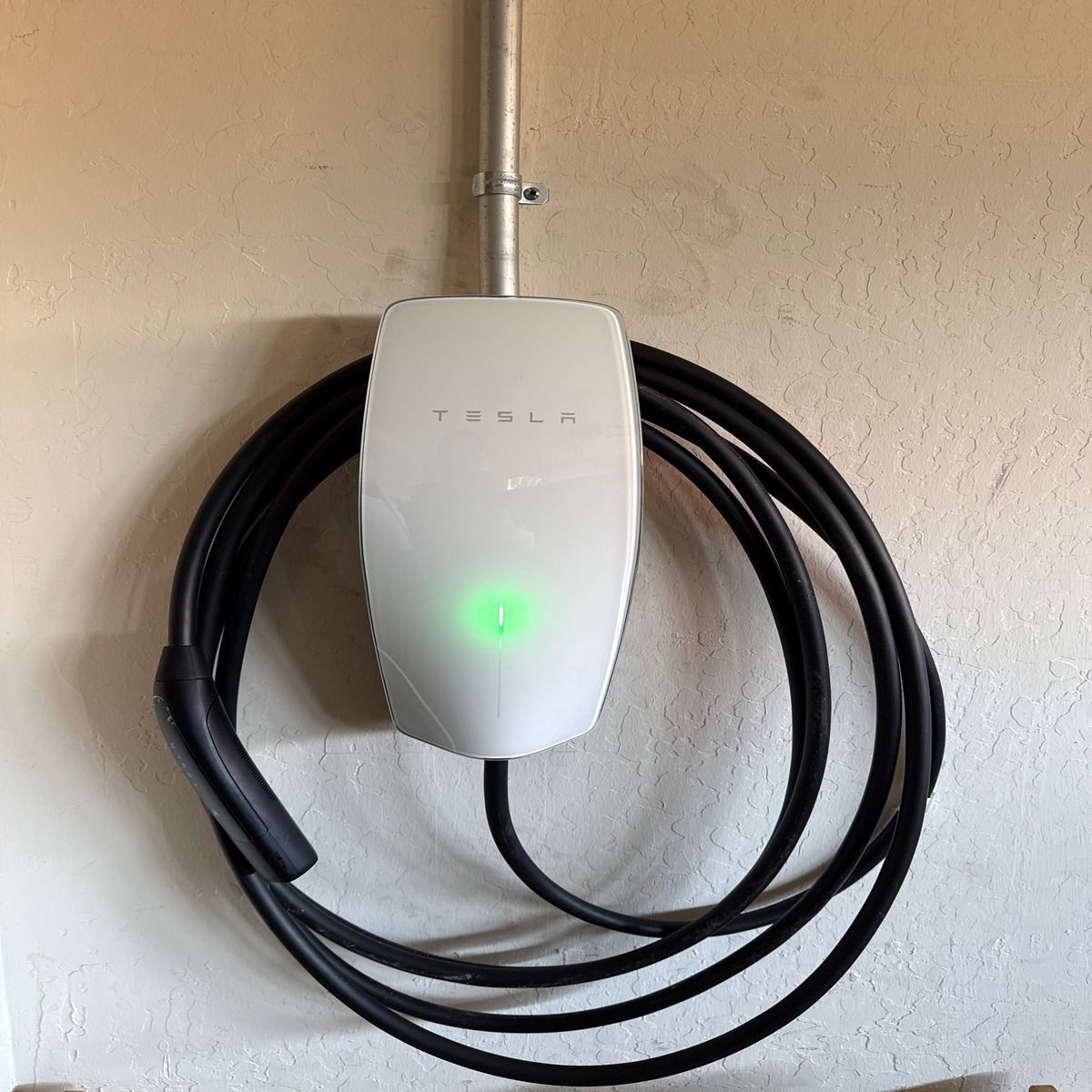
A dedicated 40- or 50-amp circuit sized for continuous EV charging loads prevents the nuisance trips that occur when chargers share breakers with other high-demand appliances. Installers route the circuit cleanly through garage walls or along exterior surfaces using conduit rated for UV exposure and thermal expansion, terminating at a properly mounted charger unit that's oriented to reduce direct afternoon sun contact wherever the garage layout allows. Tesla, Autel, Lucid, and Wallbox systems are all supported, with equipment selection guided by the vehicle's onboard charger capacity and the homeowner's daily mileage requirements.
Arizona's monsoon season, which brings lightning-generated voltage spikes from June through September, creates a specific risk for smart charger electronics even when the unit is installed inside a garage. Whole-home surge protection installed at the main panel during the same visit as the charger circuit intercepts those spikes at their entry point into the home's electrical system, protecting both the charger and other connected devices before the first monsoon storm arrives. Permit applications are submitted after the site evaluation, and inspection scheduling is coordinated by the installer — so by the time the work is complete, your Mesa installation is documented, inspected, and signed off without requiring additional follow-up on your part.
If you're ready to charge at home on a system sized for Mesa's climate and your panel's actual capacity, scheduling now means your charger is ready before peak summer demand pushes installation timelines out. Get in Touch to plan your Level 2 EV charger installation in Mesa.
Our Services in Mesa, AZ
EV Charging
Electrical
EV Charging
THE WORD ON OUR WORK
WHAT OUR CLIENTS SAY.
People who write about us tend to skip the wiring and talk about the day itself: the survey that explained the panel in plain terms, the permit that moved without a reminder, the conduit painted to match the stucco. The reviews cover what a spec sheet cannot.
What Mesa EV Owners Gain the Morning After Installation Is Complete
The practical difference a home charger makes shows up immediately — you arrive home, plug in, and the vehicle charges at 25 to 40 miles of range per hour rather than the 3 to 5 miles a standard outlet delivers. By morning, the battery is full and you leave without a detour, without a wait, and without the uncertainty of whether a public station will be available when you need it. Here's what each component of a professional Mesa installation contributes to that outcome:
- Load calculations that confirm Mesa panel capacity before installation begins, preventing breaker trips during combined AC and charging loads on hot summer nights
- Weather-rated conduit and wiring materials selected for Mesa's attic temperatures and exterior UV exposure rather than standard indoor-rated products
- Dedicated circuit installation that prevents the charger from competing with air conditioning, pool equipment, or kitchen appliances during simultaneous operation
- Whole-home surge protection that defends the charger's control board against monsoon-season voltage spikes entering through the main panel
- Full permitting and inspection coordination that produces documented code compliance — a detail that protects your home's insurability and resale value
A charger that was installed with the right materials, sized to your panel, and protected against Arizona's specific electrical hazards performs without interruption year after year. Get in touch to schedule your Level 2 EV charger installation in Mesa with a team that builds for these conditions. Contact us today.