Signs Your Electrical Panel Can't Handle an EV Charger
September 30, 2026
QUICK ANSWER: A panel that trips its main breaker, dims the lights, or feels warm to the touch when your EV charger runs does not have the spare capacity for that load. Most panels installed before the 2000s carry 100 amp service, and a Level 2 charger alone can draw 30 to 50 amps, which leaves little room once air conditioning, water heating, and kitchen appliances are running at the same time. A panel that is already full of breakers, still uses fuses, or shows scorch marks and rust needs a closer look before any charger gets added. A load calculation performed by a licensed electrician is the only way to know for certain whether your panel can carry the extra amperage or whether it needs an upgrade first.
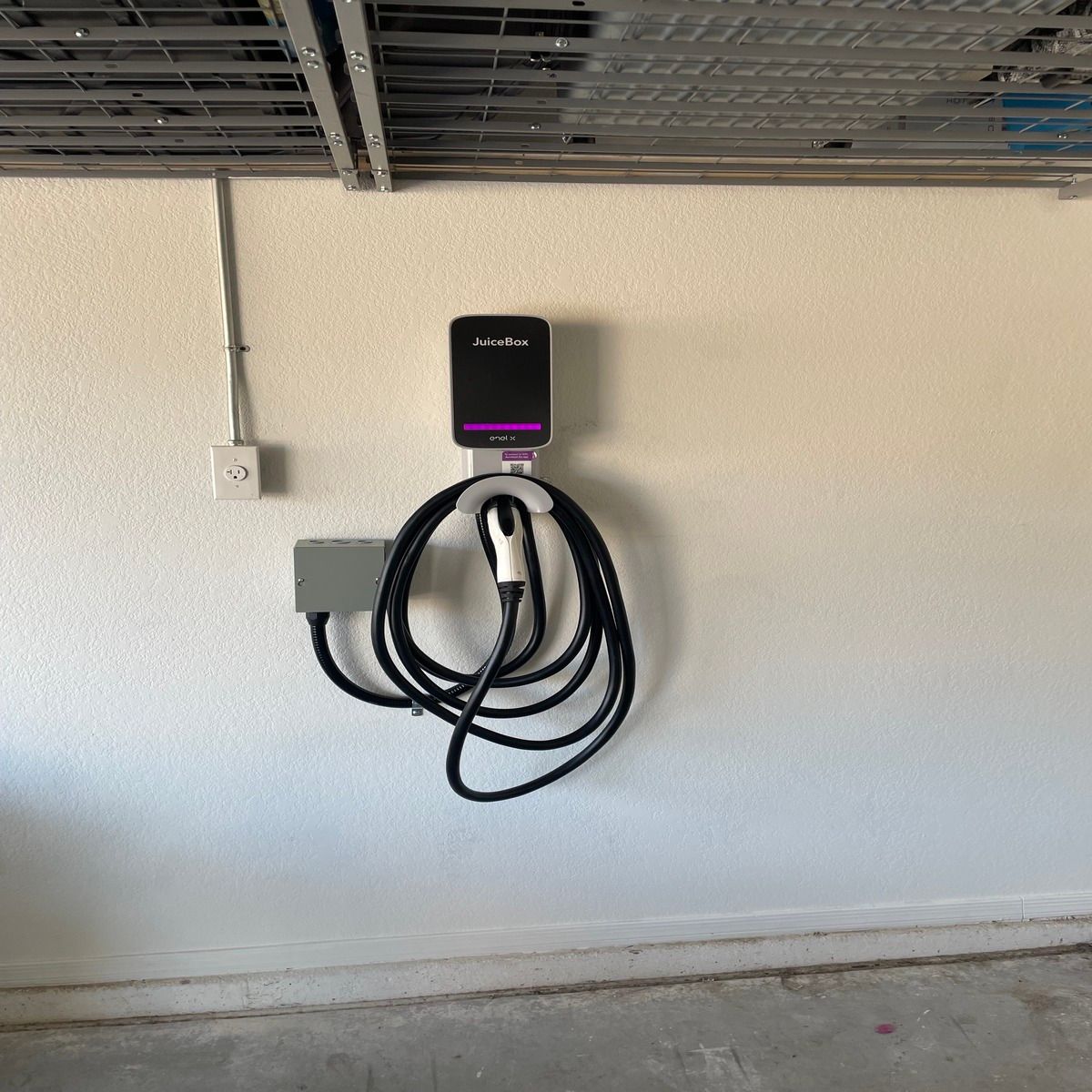
Your new EV charger sits bolted to the garage wall, cable coiled and ready, and the first time you plug in overnight the breaker trips before the coffee even finishes brewing. Or maybe nothing trips at all, but the kitchen lights dim every time the charger kicks on and the microwave decides to stop mid cycle. Neither reaction is random. It is your electrical panel telling you, in the only language it has, that it is being asked to carry more than it was built for.
We get these calls constantly across the Phoenix Valley, from Scottsdale to Chandler to Gilbert, usually a week or two after a charger install from a big box retailer or a general contractor who skipped the load calculation. The charger itself is rarely the problem. The panel underneath it, sized decades ago for a smaller home with fewer appliances, is.
How Much Power a Level 2 Charger Actually Pulls
A Level 2 home charger is not a minor addition to your electrical system. Most residential units draw between 30 and 50 amps continuously, and because EV charging counts as a continuous load under the National Electrical Code, the circuit feeding it has to be sized for 125 percent of that draw rather than the draw itself.
Continuous Load Math
A charger pulling 40 amps needs a breaker and conductor rated for at least 50 amps, since a continuous load only gets credited for 80 percent of a circuit's rating. A Tesla Wall Connector, as one example, is commonly installed on a 40 amp or 50 amp breaker depending on the vehicle and the charging speed a homeowner wants, according to Tesla's own installation guidance. That single circuit can represent close to half the usable capacity of an older 100 amp panel before you even account for the oven, the water heater, or the air conditioner cycling on in July.
Once you see the math laid out this way, the breaker trips stop feeling random.
Circuit Breakers That Trip Every Time You Plug In
A breaker that trips the moment charging starts is not being oversensitive. It is doing exactly what it was designed to do: cutting power before a wire carries more current than it is rated to handle safely. If the trip happens every single session, the circuit feeding the charger is undersized for the load, the panel itself is near its ceiling, or both.
This is different from a breaker that trips occasionally, say on the hottest afternoon when the air conditioner, the pool pump, and the charger all happen to be running together. That pattern points to a panel with just enough spare capacity for normal use but none left over for a dedicated 240 volt charging circuit. Either way, repeated trips are the panel's clearest possible signal, and homeowners who reset the breaker and keep charging anyway are asking a stressed circuit to keep absorbing damage it is already showing.
TIP: If your breaker only trips on the hottest days of summer, note the outdoor temperature when it happens. Heat raises resistance inside an aging panel's bus bar, so a panel that limps through cooler months can fail well below its rated amperage once Phoenix highs push past 110 degrees.
Dimming Lights, Buzzing Sounds, and Warm Panels
Not every overloaded panel trips a breaker before something else gives out first. According to the Electrical Safety Foundation International, the warning signs of an overloaded electrical system include frequent breaker trips, lights that dim when another device turns on, a buzzing sound from switches or outlets, discolored outlets, and appliances that seem to run underpowered.
If your kitchen lights flicker every time the charger cycles to a higher amperage, that is voltage sag, not a coincidence. And a panel cover that feels warm to the touch, even slightly, is not something to wait out. Warmth at a panel means current is meeting more resistance than it should, usually at a loose lug or an overworked bus bar, and that resistance only gets worse the longer a heavy load like EV charging keeps running through it.
What Your Panel's Age and Amperage Rating Actually Tell Us
Open the panel door and the amperage rating is usually stamped right on the main breaker or printed on the inside of the door. The average American home was built in 1977, according to the Electrical Safety Foundation International, and a huge share of Phoenix Valley homes from that era, along with plenty built through the late 1990s, were wired for 100 amp service.
A 100 amp panel was never designed with EV charging in mind. It was sized for a smaller mix of appliances, window units instead of central air, and none of the load management modern households now expect from a single service. Add a 30 to 50 amp charging circuit to a 100 amp panel that is already running central air conditioning, an electric range, and a water heater, and you can be asking the service itself, not just the panel's breaker slots, to carry more than its rated capacity.
Panels That Are Already Out of Breaker Space
Some panels never trip and never buzz, but they still cannot take on a new EV charging circuit because there is nowhere left to put it. Every slot is filled, tandem breakers are already doubled up where the panel design allows it, and there is no physical room for the double pole breaker a Level 2 charger requires.
A subpanel can sometimes solve this without touching the main service, but only if the main panel has enough spare amperage to feed it. If the main service is already near capacity, adding a subpanel just relocates the same problem to a second box. This is exactly the kind of judgment call that belongs to a load calculation, not a guess based on how full the panel looks.
Aluminum Wiring, Fuse Boxes, and Other Red Flags Inside Older Panels
Homes wired in the 1960s and 1970s sometimes used aluminum branch circuit wiring instead of copper, and aluminum expands and contracts differently at connection points, which can loosen terminals over years of heating and cooling cycles. If your home still runs on a fuse box rather than circuit breakers, that alone is a sign the electrical system predates modern EV charging entirely and needs evaluation before anything gets added to it.
Panels built by certain manufacturers decades ago, including some Federal Pacific and Zinsco models, carry a documented history among electricians and home inspectors of breakers that fail to trip when they should under overload conditions. If your panel carries one of those older labels, that is worth flagging during a load evaluation regardless of whether an EV charger is part of the plan.
WARNING: Electrical malfunctions cause roughly 35,000 home fires a year, according to the Electrical Safety Foundation International. A panel that is warm, buzzing, or showing scorch marks near the breakers should be treated as an active hazard and checked by a licensed electrician before it carries another charging cycle, not after.
Phoenix Valley Heat and Monsoon Season Add Extra Strain
Panels here work harder than panels in milder climates, and that matters for how quickly warning signs show up. Extended summer heat pushes attic and garage temperatures well above the ambient outdoor reading, and plastic breaker housings and wire insulation degrade faster at those elevated temperatures than manufacturers' ratings assume for a typical installation. A panel that would coast along fine in a cooler state can show its age here years sooner.
Monsoon season adds a second stress. Voltage surges from utility grid fluctuations during storm season put extra load on breakers and connections that may already be marginal, and a panel running close to its limit with an EV charger added has far less tolerance for that kind of spike. We see a noticeable jump in panel related service calls every August and September, right when storm activity peaks and cooling loads are still at their highest.
What a Load Calculation Actually Checks
A load calculation is not a guess, and it is not the same thing as reading the amperage stamped on the panel door. It works through your home's existing circuits room by room, adds the demand from planned equipment like a Level 2 charger, and applies the same demand factors and continuous load rules an inspector would use to confirm the numbers, following the process outlined in the National Electrical Code.
The calculation also checks something homeowners rarely think to ask about: whether the utility service line feeding the panel, not just the panel box itself, has enough capacity for the new total. A panel swap does no good if the wire running from the meter can't support the higher amperage. Pulling a permit and scheduling the utility's inspection is a standard part of that process here, the same way it is on any electrical project that changes a home's service capacity, and it gives you a documented record that the finished work meets current code rather than just a verbal assurance.
Frequently Asked Questions
How much amperage does a home EV charger typically need?
Most Level 2 chargers draw between 30 and 50 amps, and because that draw is continuous, the circuit feeding it needs to be rated for 125 percent of that number. A charger pulling 40 amps, for example, generally sits on a 50 amp breaker once the continuous load math is applied.
Can I still install an EV charger if I only have a 100 amp panel?
Sometimes, but it depends on what else is already running on that panel. A load calculation will show whether there is enough spare capacity for a dedicated charging circuit or whether the panel needs to be upgraded first.
Does a flickering light always mean the panel cannot handle a charger?
Not always, but it is a signal worth paying attention to. Occasional dimming during a high draw moment can be normal in an older home, while dimming that happens every single time the charger cycles points to a panel running close to its limit.
How can I tell what amperage my panel is rated for?
The rating is usually printed on the main breaker itself or on a label inside the panel door. If neither is legible, an electrician can confirm the rating during a load evaluation along with the panel's overall condition.
Is a subpanel a substitute for a full panel replacement?
Sometimes, but only if the main service already has enough spare amperage to feed it. A subpanel added to a service that is already near its limit just moves the same capacity problem to a second box instead of solving it.
How long does a load evaluation take before we know if an upgrade is needed?
A standard residential load evaluation usually takes a couple of hours on site, including a walkthrough of existing circuits and a visual inspection of the panel itself. You generally get a clear answer the same day on whether the existing panel can support a Level 2 charger or whether an upgrade needs to happen first.
What These Warning Signs Really Mean for You
A panel that trips, dims, or warms up under a new EV charger is not failing at random. It is showing the limits of a system built for a smaller list of appliances decades before anyone planned to charge a car in the garage overnight. Aluminum wiring, fuse boxes, and panels already packed with breakers only add to that strain, especially once Phoenix summers push temperatures inside the box well past what the panel was rated for when it went in.
A load calculation replaces that guesswork with an actual number, and it remains the only reliable way to know whether a panel can carry a Level 2 charger safely. MaxCharged
has spent 10
years working on electrical panels and
EV charging
circuits across Phoenix, Arizona, and that experience shows up in every load evaluation performed for a homeowner considering the switch to electric. The answer is rarely as simple as the panel's age alone would suggest.
More EV Charging Articles